Can Your Clinic Prove Its Marketing Works? We Checked 559 Vet Websites (2026)
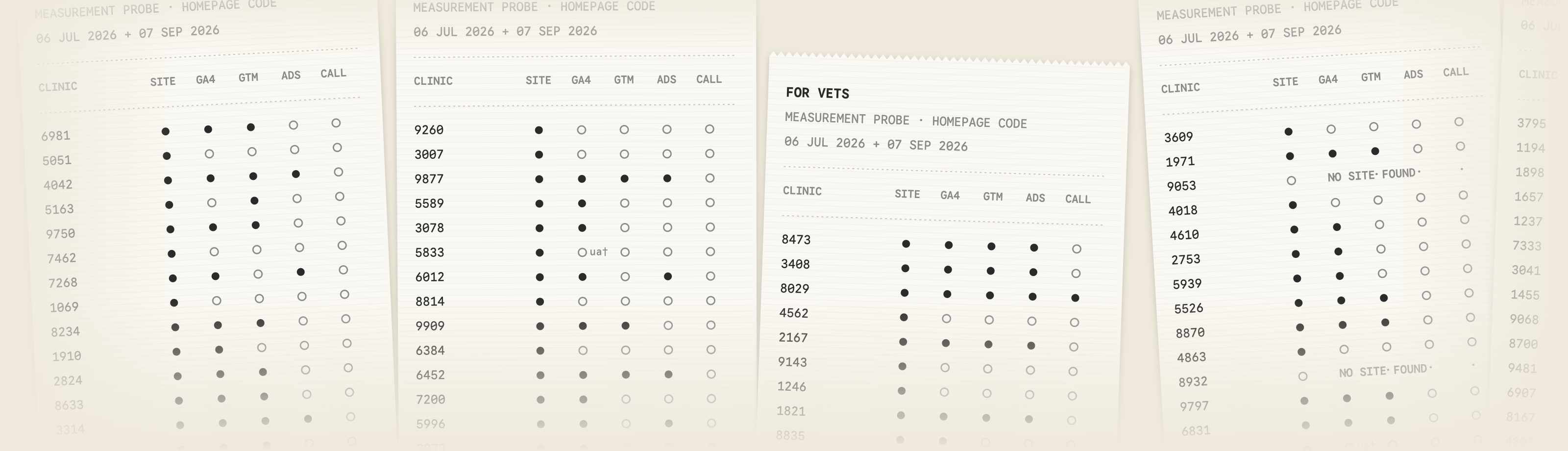
We checked 559 Australian vet clinics for the basic measurement stack: analytics, a Tag Manager container (Google’s tool for loading other tags), a Google Ads conversion tag and call tracking. We read the public code of every website we could find. Of the 537 we could assess, 32% cannot measure anything that happens online, because we found no website or the website carries no Google analytics.
Among clinics that pay for Google Ads the gap sits elsewhere: nearly all have analytics, but 63% have no Ads conversion tag anywhere, so they can count visitors without knowing whether the spend books a single appointment. And in an industry that runs on phone calls, call tracking is visible on 2 of the 501 websites we could read.
| Author | Jai, For Vets |
| Sample | 559 Australian vet clinics on the roster; 537 assessable (501 websites read, 36 without a website found); 243 advertisers' websites read |
| Data source | Public homepage code and public Google Tag Manager container configuration; advertiser status from the Google Ads Transparency Center, June 2026 |
| Reading time | 10 min |
Key findings
32% of the clinics (171 of 537) we could assess cannot measure anything online.
36 have no website we could find, and another 135 have a website carrying no Google analytics of any kind, not even a dead tag.
The gap splits on whether the clinic advertises on Google.
Among clinics we did not find advertising in June 2026, 52% cannot measure anything online (including the no-website group). Among the 243 advertisers whose sites we could read, only 8% lack Google analytics entirely.
But 63% of advertisers have no Google Ads tag anywhere.
No conversion tag, no remarketing tag, on the site or inside their Tag Manager container. They can count the clicks they buy, but Google Ads cannot see which of those clicks became a booking.
18% of clinic websites still carry a Universal Analytics tag, which Google switched off on 1 July 2023.
For 50 sites (10%), that dead tag is the only analytics installed: every visitor since July 2023, none of them recorded.
One in five GA4 installations is a double-count risk.
GA4 is the current version of Google Analytics. The same measurement ID is hardcoded in the page and loaded again through Tag Manager, which can inflate every traffic number the clinic reads.
Call tracking is visible on 2 of 501 websites.
Clinics are phone-first businesses; 84% of these sites have a tap-to-call link, and almost none show any website-side way to attribute the resulting calls to a source. Two is a floor: the probe reads homepage code only.
As many vet websites carry a Meta (Facebook) pixel as a Google Ads tag
21% vs 20%, even though search is where a pet owner who needs a vet actually looks.
1. Three in ten clinics we assessed cannot measure anything online
Of 537 Australian vet clinics we could assess, 171 (32%) cannot measure anything that happens online: 36 have no website we could find, and 135 have a website with no Google analytics installed (For Vets, 2026).
The roster is the same 559-clinic screening list behind our advertising study (metro-skewed, about one in seven of the roughly 3,800 practices in Australia). The probe read each clinic’s public homepage code plus, where a Tag Manager container was present, the container’s own public configuration. Twenty-two sites returned no readable homepage and are excluded from every figure rather than counted as tag-free.
Measurement follows marketing intent. Clinics we found advertising on Google in June 2026 almost always have analytics (224 of 243, 92%). Clinics we did not find advertising mostly do not: 45% of their websites carry no Google analytics at all. Once the no-website clinics are included, 52% of the clinics we did not find advertising have no way to measure anything online. The blind spot is concentrated almost entirely in the clinics we did not find advertising on Google. The average clinic deciding whether to start advertising is therefore deciding with no baseline of what its website already does.
What this means for a practice owner:
Before any marketing decision, the measurement question comes first. A clinic with no analytics on its site cannot know what the site produces now, so it cannot know whether any future spend changed anything.
2. Dead tags: 18% of sites still carry analytics Google switched off in 2023
88 of 501 clinic websites (18%) still carry a Universal Analytics tag. Google stopped processing Universal Analytics data on 1 July 2023. For 50 of those sites (10% of all we read), the dead tag is the only analytics present (For Vets, 2026).
Universal Analytics was Google’s standard web analytics tool for about a decade, and Google retired it in July 2023: standard properties stopped recording on 1 July 2023. A UA tag left in the page does nothing except suggest nobody has looked at the site’s code since. The 38 sites carrying UA alongside a GA4 tag have a maintenance job. The 50 sites carrying UA alone have something worse: an owner who may genuinely believe the clinic has analytics, while every visit, call and booking click since July 2023 has gone unrecorded.
What this means for a practice owner:
If your analytics was set up before 2023 and nobody has touched it since, check the tag. If it starts with UA- rather than G-, you have been unmeasured since July 2023.
3. Six in ten advertisers have no Google Ads conversion tag
Of 243 advertising clinics whose sites we could read, 153 (63%) have no Google Ads tag anywhere: no conversion tag, no remarketing tag, not in the page and not inside their Tag Manager container (For Vets, 2026).
This is the inversion at the centre of this report. Most advertisers install analytics, but six in ten have not installed the tag that connects a click to a booking. Without an Ads tag on the site, Google’s system cannot see that a click became a booking-form submission, and the clinic cannot see which campaign, keyword or suburb produced a customer rather than a visitor. It also usually means no remarketing audiences, so a pet owner who visited once is gone.
The honest caveats, because an on-site tag is not the only path: conversions can also be measured through Google’s call-forwarding numbers, imported from GA4, or uploaded offline, and our probe reads homepages rather than every inner page. So 63% overstates total conversion blindness. The floor is the group with neither an Ads tag nor GA4 anywhere: 20 advertisers (8%) with no possible website-side conversion path at all. Between the floor and the 63% sits a large group whose best case is indirect measurement they would need GA4 discipline to use, and 30 advertisers (12%) do not have GA4 either.
One comparison makes the misdirected effort vivid: 21% of clinic websites carry a Meta pixel, 20% a Google Ads tag. As many clinics have tagged their site for Facebook as for the channel where a pet owner types “vet near me” with a sick dog on their lap.
What this means for a practice owner:
If you advertise, the first audit question is whether a conversion tag exists, before anyone looks at the ad copy. Spend optimised against visits drifts to whatever produces cheap clicks; spend optimised against bookings needs the tag that sees bookings.
4. One in five GA4 setups double-counts
Of 304 sites with GA4, 60 (20%) load the same measurement ID twice: once hardcoded in the page and again through Google Tag Manager (For Vets, 2026).
The pattern is easy to create: a site builder or plugin inserts GA4 directly, then an agency adds Tag Manager (or the reverse), and nobody removes the older install. Both tags can fire on every page, so traffic can inflate, engagement metrics can distort, and any conversion counted through the page can register twice. Of the sites with GA4, 84 run it hardcoded only, 154 through Tag Manager only, and 66 have both delivery routes present, 60 of them with the identical ID visibly duplicated.
WordPress powers 76% of the sites where we could identify a platform (303 of 396), so most double-installs sit on WordPress sites. The rate was no lower on the other platforms we could identify: 20% of WordPress GA4 sites, 20% elsewhere, on small numbers. The layering comes from how sites are managed rather than from the platform.
What this means for a practice owner:
If your numbers look surprisingly good, verify before celebrating. One minute in the browser: view the page source and search for id=G- and for GTM-. If both appear, ask whoever manages the site to confirm the GA4 tag is not also loaded inside Tag Manager.
5. Call tracking is almost absent
Call tracking is visible in the homepage code of 2 websites out of 501 (For Vets, 2026).
Vet clinics are phone businesses. Many bookings still start with a call, and 84% of these websites carry a tap-to-call link inviting exactly that. Yet the tooling that connects a call to its source, dynamic number insertion from providers like CallRail, WildJar, Delacon or Jet Interactive, is visible on two sites in the entire dataset. Our probe reads homepage code only and cannot see trackers deployed purely inside Tag Manager containers, so treat two as a floor. Even if the true number were several times higher, adoption would still be in the low single digits of a phone-first industry.
The practical consequence compounds the Section 3 finding: for a clinic whose conversions are mostly calls, an Ads tag alone still misses the majority channel. On the website evidence alone, almost no clinic can say “this campaign made the phone ring 30 times”. Google’s call reporting on ads, which the probe cannot see, is the one exception.
What this means for a practice owner:
If the phone is how you get clients, call measurement is the primary meter rather than an advanced feature. Options run from Google’s free forwarding numbers on ads up to full dynamic number insertion on the website.
Methodology and boundaries
- Sample. The 559 clinics on the roster built for our advertising study (561 businesses there; two duplicate domains merged here). The roster is metro-skewed, so the figures describe this roster rather than the country. It covers about one in seven of the roughly 3,800 practices in Australia (AVA).
- Probe. One polite fetch of each clinic’s public homepage, with a single retry on timeout, recording the measurement signals in the returned code: analytics IDs, Tag Manager containers, Google Ads tags, the Meta pixel, call-tracking providers, booking links and tap-to-call links. The main run was on 6 July 2026; 36 advertisers whose website address our roster had not recorded were looked up and probed the same way on 7 September 2026.
- Tag Manager step. For every container found we also fetched its public configuration and extracted the GA4 and Ads IDs inside it. Without that step, 154 sites whose analytics loads only through Tag Manager would have been wrongly counted as analytics-free.
- Exclusions. Twenty-two sites returned no readable homepage (10 DNS failures, 6 TLS errors, 5 HTTP errors, 1 timeout). They are excluded from every statistic and never counted as tag-free.
- Direction of bias. Every tag count is a floor, so every “no tag” figure is a ceiling. The probe cannot see tags installed only on inner pages, server-side tagging, analytics tools other than Google’s, or call tracking deployed purely inside Tag Manager. Each section states which way its figure could be wrong.
- Ads tag absence. A missing Ads tag does not prove a clinic measures nothing: Google’s call-forwarding numbers, GA4 import and offline uploads exist. The report therefore also gives the stricter figure, the 8% of advertisers with neither an Ads tag nor GA4, who have no website-side conversion path at all.
- Advertiser status. From our June 2026 Google Ads Transparency Center screening, so a clinic that started or stopped advertising since is misclassified. The figures are a point in time.
- Validation. One roster clinic’s measurement stack is configured by us and served as a known-good check: the probe recovered its container, its Ads tag and its call tracking exactly.
- Disclosure. We sell the service this report finds missing. That conflict is why every claim is scoped, why the probe’s limits are stated, and why no per-clinic data is published. Aggregates only, because a row-level list of under-instrumented clinics would be a prospecting list dressed as research.
How to cite this report
For Vets, Can Your Clinic Prove Its Marketing Works? We Checked 559 Vet Websites (2026). Probe of public website code, collected 6 July 2026 with 36 sites added 7 September 2026; n=559 Australian vet clinics (537 assessable). https://www.forvets.au/research/vet-marketing-measurement-2026
Sources
- Google, “Universal Analytics is going away” (support.google.com/analytics/answer/11583528): standard properties stopped processing hits on 1 July 2023.
- Australian Veterinary Association, home page (https://www.ava.com.au/), accessed 6 September 2026: “Across 3,793 practices and a workforce of nearly 30,000 people”.
- Google Ads Transparency Center, June 2026 screening (our advertising study).
| Last verified | 07/09/2026 |
| Version note | v2 text, 7 September 2026; data collected 6 July 2026 with 36 sites added 7 September 2026 |