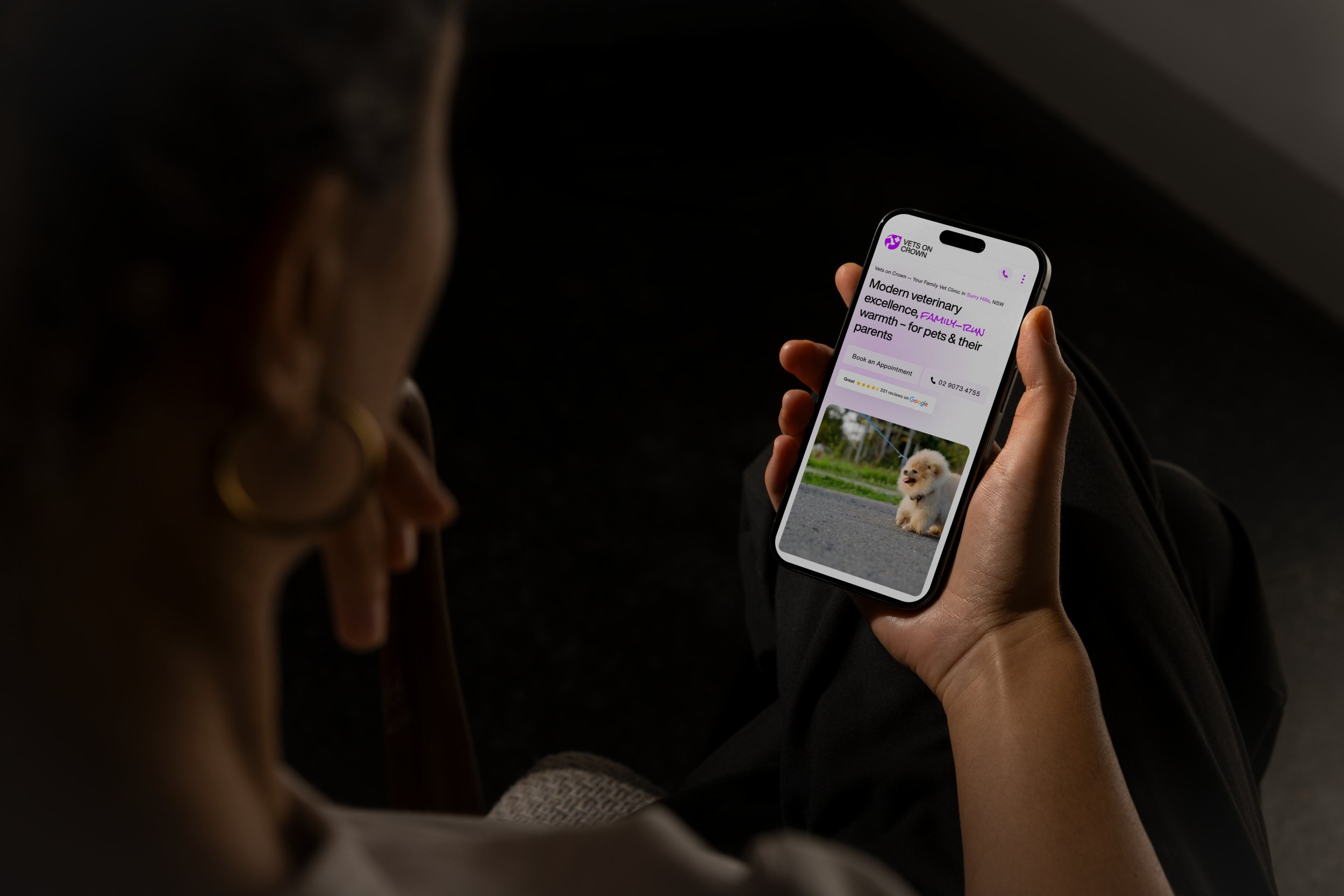
Website Design & Development for Vet Practices
We build websites for vet clinics that pet parents stay on and remember.
There are two kinds of clinic website: the one for pet parents who already know you, and the one that has to win a stranger.
Most clinic websites are the first kind: a business card. A pet parent who already trusts you looks up the hours, checks the address and books. If your books fill by word of mouth, that site is honestly enough.
Growth is a different job. The pet parents you want next have never heard of you, and no ad or ranking can convince them on its own. Marketing puts your clinic in front of the right pet parent at the right time, and buys one click.
Everything after the click is the website.
A stranger lands with one question: can I trust this clinic with my pet? The rest of this page is how we build the site that answers it.
Stage 1 / Brand Voice
Design starts after the words. First we work out what your clinic can say that is true, specific and yours, because a beautiful site saying the same lines as every other clinic gets forgotten with them.
We read every review to find what pet parents praise you for
We pull every review of your clinic and of the clinics near you, not the handful Google shows, and read them all. What pet parents praise you for, and what they complain about elsewhere, becomes the words on your site. The best line on your site is often one a real client already wrote.
Your story, told so a pet parent can picture a visit
We take why you opened the clinic, what you do differently, and the credentials you would never think to mention, and write them so a pet parent can picture what a visit would be like. One example: for Gentle Vet Care, a mobile vet in Melbourne's west, the core idea running through the whole site is that the vet comes to your home, and your dog is checked on the sofa where it naps. A pet parent reads that and can already picture the visit.
A claim the clinic up the road cannot make
We check every headline the same way: could the clinic up the road say the same thing and have it be true? If they could, we keep working. When no single claim survives that test, we take what is true about you and write it vividly enough to picture instead. That is what makes a pet parent comparing three clinics remember yours.
Stage 2 / Design
Nothing starts from a template. Your site is designed for your clinic alone, and every design choice has one job: to get the words from Stage 1 read and believed.
Designed to a higher standard than vet websites usually get
Most vet websites copy other vet websites, so they all look alike and none of them stands out. We study the best-designed websites in other industries, where the standard is far higher, and build your site to that standard. A pet parent who has looked at three vet sites this week sees a clinic that looks as well run as the brands they already trust, and remembers it.
Real photos of your vets and nurses where a pet parent is deciding
Before booking, a pet parent wants to see who will handle their pet. So real photos of your vets and nurses with patients go in the important areas of the important pages, where a pet parent is deciding, and each vet gets their own profile: their background, and what they are like in the consult room. One example is Caring Paws, a new clinic in Melbourne's east, where the team is on the pages a pet parent reads before booking. A stranger chooses a person they trust, not a building.
Scroll animation that gets your whole story read
Your clinic's story is long: why you opened, what you do differently, who your vets are. On most sites it sits in one block of text and gets skipped. On yours, the words are animated. As a pet parent scrolls, one sentence fades in, holds on the screen while they read it, then makes way for the next, and the photos and cards slide in beside the words at the right moment. It works like a presentation the reader controls with their thumb, so nothing is skipped and the whole story gets read. You are on a site built this way now: scroll and watch how the text arrives. The longer a pet parent reads, the more they trust the clinic.
The site keeps growing after launch
Every part of the design is built once and reused, so when a new vet joins, you start serving a new suburb or you add a service, the page goes up fast. There is no design fee for it, and every new page is one more page Google can rank you for.
Stage 3 / Development
The build is judged twice. A pet parent sees the design. Google reads the structure underneath. These two needs work against each other, and a lot of our work goes into serving both at once.
Simple code that Google can read
Google reads tables, lists and headings best. Pet parents find those formats boring. So we build the page as both: Google reads a plain numbered list, and a pet parent sees cards sliding in.
Fast for a sick pet, animated for the puppy owner comparing clinics
Two kinds of pet parent land on your site. One has a dog that has been vomiting since the morning and wants your number and your hours now, so every page loads fast on a phone and the animation never holds them up. The other has a new puppy and is comparing three clinics over a week. They are the ones who read the story, and the animation is built for them.
Your reviews built into the site, where Google reads them
Most clinic sites show reviews through a third-party widget, a box that loads the reviews from somewhere else. A pet parent can see them, but Google does not read them as part of your site, so they do nothing for your rankings. We build your reviews into the page itself, as text Google reads like any other, with a fresh set on every visit. A pet parent reads real reviews without leaving your site, and Google sees a site that keeps changing.
FAQ
I already have a website
Most clients did. We rebuild rather than patch, because the old template is usually what holds the site back. Your content and anything that ranks moves across, with every old page address pointed at its new one, so the history is kept.
Will a rebuild hurt my Google rankings?
The risk is real when a rebuild is done carelessly. So every old page address redirects to its replacement, rankings are checked before and after, and you can watch them in the report. The check matters: 18% of the 501 vet websites we read still carry a Google tracking tag that Google switched off in 2023, and one in five has Google Analytics counting every visit twice. Ramsgate Vet had its site rebuilt this way and kept its rankings; the case study has the detail.
Who makes changes after launch?
We do. A new vet joins, a consult fee changes, the clinic closes for a public holiday: send it through and it gets built. You never maintain the site yourself.
Do you write the content?
Yes. The brand voice stage is the writing: the vet bios, the service pages, the local pages. You are never sent away to write your own pages.